
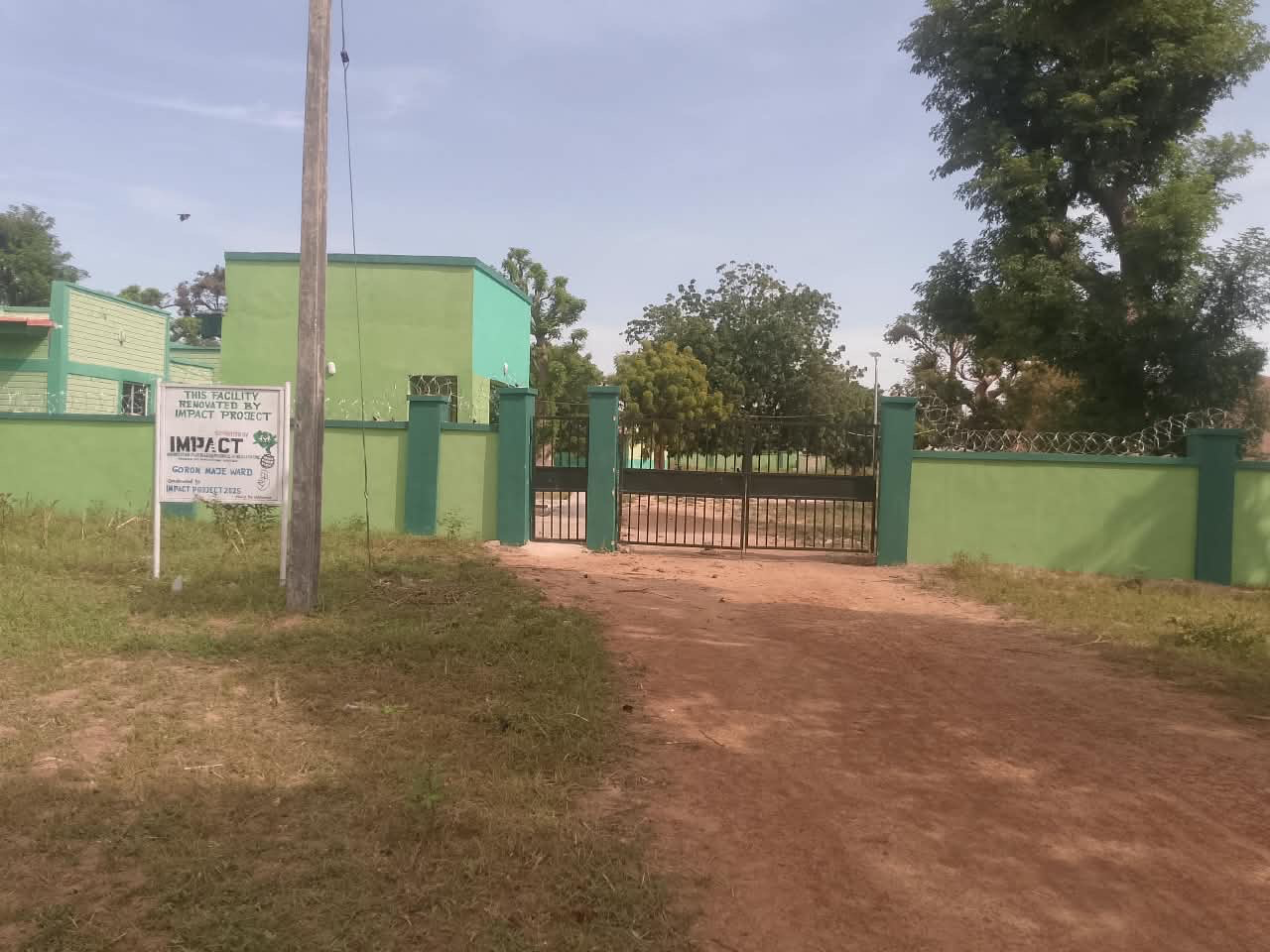
A recent renovation has improved the facility, but Goron Maje women still face shortages of medical personnel and essential equipment, limiting access to timely maternal care.
By Mariya Shuaibu Suleiman
Across rural Kano, government investments are improving the physical infrastructure of primary healthcare facilities, but many communities still face gaps that affect the care available to them. At Goron Maje Basic Health Clinic, a recently renovated facility in Danbatta LGA, women continue to contend with a shortage of medical personnel, no resident doctor and inadequate essential equipment. In this investigation, Mariya Shuaibu Suleiman exposes the gap between improved infrastructure and the resources needed to provide effective healthcare in the remote community.
When Suwaiba Mamuda (not her real name, used to protect her identity) was due to give birth in August this year, she could not use Goron Maje Basic Clinic, the only healthcare centre in her community.
Other women were already at the hospital, waiting to deliver their babies.
There was only one midwife available to attend to them, according to Mrs Mamuda and her husband, Mamuda Ibrahim (not his real name, used to protect his identity).
Worried about what might happen if she went into labour there, Mr Ibrahim took his wife to a hospital in city, more than 110 kilometres away from their community.
The journey meant leaving behind the health facility closest to their home and travelling along roads that residents say can be difficult, with motorcycles serving as the most common means of transportation in the area.
Goron Maje is a rural community in Danbatta, one of Kano State’s 44 local government areas. Danbatta is in the northern part of the state, away from Kano metropolis, and the journey to the state capital can take considerable time depending on the route and means of transportation.
For residents of Goron Maje, the primary healthcare centre is therefore more than just a nearby clinic. It is the main health facility available to the community.
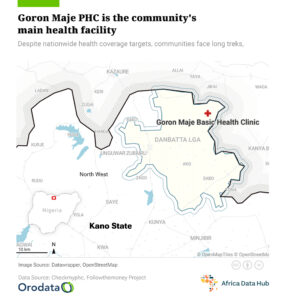
But while the building has recently undergone renovation, the people working inside it say the facility still lacks some of the personnel and equipment required to provide comprehensive 24-hour maternal healthcare.
A facility without a doctor
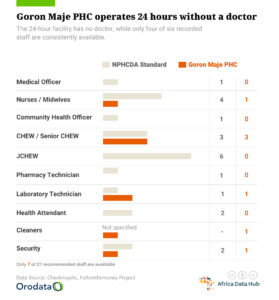
The facility operates around the clock, but there is no doctor, according to Amir Musa Adamu, the second-in-charge at the centre.
The facility has six staff members on its records, but only four are consistently available.
An environmental health officer comes about once a month, while another official assigned to the facility does not report regularly, he said.
The shortage is more pronounced among professional healthcare workers.
According to a health worker at the facility who has worked there for 14 years but asked not to be named because he was not authorised to speak publicly, several of the professionals working regularly are temporary or volunteer workers.
He said the facility has about four to five such professional volunteers.
The health worker said one of the workers receives only ₦10,000 monthly, although he did not describe the payment as a regular government salary.
The absence of a doctor is the most significant gap, he said.
There is also no doctor on call to respond when a patient develops a serious complication, including during childbirth.
“Sometimes when a woman gives birth, she can start bleeding,” the health worker said, explaining that the absence of a doctor makes such situations more difficult to manage.
He urged the government to provide a doctor for the facility, adding that even an on-call doctor would make a difference during emergencies.
The health worker noted that the facility previously attended to about 30 patients daily and sometimes more, making the staffing shortage more significant.
 Side view of the Goron Maje Basic Health Clinic. (PHOTO CREDIT: Mariya Shuaibu Suleiman)
What a 24-hour PHC is expected to provide
The staffing situation at Goron Maje raises questions about whether the facility has the personnel required to safely sustain the 24-hour services it provides.
The National Primary Health Care Development Agency (NPHCDA), defines a functional Level 2 primary healthcare facility as one where “everything” is in place for a pregnant woman to deliver safely around the clock. Its current requirements include four to six skilled birth attendants where accommodation is available, or at least six where there is no accommodation.
The agency also requires Level 2 facilities to have reliable electricity around the clock, backup solar power, water and sanitation facilities, delivery and labour wards, laboratory services and other basic infrastructure.
The NPHCDA’s Priority PHC Initiative similarly describes a functional PHC as one with basic equipment and commodities, at least four skilled birth attendants, regular water and electricity and accommodation for health workers to enable uninterrupted 24-hour services.
The agency’s emergency maternal and child health programme also aims to ensure at least four skilled birth attendants at the focal PHC in every ward.
The situation at Goron Maje is therefore not simply about the number of people working at the facility. It affects the centre’s capacity to respond when routine childbirth becomes an emergency.
A concern beyond Goron Maje
Maryam Tanimu, a mother of two in the community, knows how quickly such emergencies can arise.
She said she had experienced complications during previous childbirth and sometimes bled.
“I had some complications and bleeded in my last delivery, I am scared what would happen if that happens again and with no doctor to help me.”
Those experiences made her afraid of delivering at Goron Maje because there is no doctor available to assist if her condition suddenly deteriorated.
Her concern reflects one of the central risks associated with maternal healthcare in remote facilities: complications can develop quickly, while the capacity to manage them may be limited.
She said she feared that if she began bleeding or developed another complication during delivery, there would be no doctor at the facility to intervene.
Her concern comes against a recognised risk in maternal healthcare.
Nigeria’s National Guideline for the Management of Postpartum Haemorrhage, published by the Federal Ministry of Health and Social Welfare, says postpartum haemorrhage is associated with significant morbidity from delayed diagnosis, inadequate skills to manage the condition, poor-quality or inadequate medical supplies and the non-availability of safe blood and transfusion services during emergencies.
The guideline says women at risk should present to facilities with skilled birth attendants and blood transfusion services where necessary.
The staffing challenge at Goron Maje also mirrors a wider problem documented across Nigeria’s primary healthcare system.
A September 2026 assessment of 1,480 PHCs across 16 states by PREMIUM TIMES found that only three per cent met the national minimum staffing requirement.
The PHC Operational Capability Report, produced by Orodata Science and Civic Tech, assessed facilities in 277 local government areas across the six geopolitical zones. The assessment, conducted between October 2023 and June 2025, examined staffing, infrastructure, equipment, electricity, water supply and accessibility.
About 75 per cent of the facilities assessed were in rural communities, where PHCs often serve as the first, and sometimes only, formal source of healthcare for residents.
The assessment also found that 75 per cent of the facilities lacked essential neonatal resuscitation equipment. It identified Kano and Sokoto among states with particularly serious gaps in safe water, reliable electricity and essential newborn-care equipment.
The findings put Goron Maje’s situation into a wider context, but the problems at the facility remain specific.
Read Also: Kano Moves to Sustain Maternal Health Gains After AEARI Project Success
The building has recently been renovated.The centre provides maternity services and operates 24 hours but the workers interviewed for this report said it does not have a doctor, has limited regular personnel and lacks some equipment needed to support patients when complications arise.
What the budget provides
Kano State’s 2026 approved budget also contains several allocations directed at primary healthcare.The budget provides ₦472.5 million for the renovation and maintenance of primary healthcare facilities across the state.
The scale of the government’s planned investment in healthcare was also highlighted by the Commissioner for Health, Dr Abubakar Labaran, who said in January 2026 that more than ₦40 billion had been proposed for the health sector. He explained that the allocation was intended to consolidate ongoing reforms and strengthen healthcare delivery across the state. He also said the government had commenced the recruitment of more than 2,600 health workers, including medical doctors, nurses, midwives, environmental health officers and laboratory scientists, to address manpower shortages in hospitals and primary healthcare centres.
The approved 2026 budget, however, contains specific allocations for primary healthcare under the Primary Health Care Management Board. It allocates ₦2.4306 billion for the implementation of the Minimal Service Package Investment Plan, while ₦100 million is provided for oversight visits to PHCs across the state’s 44 local government areas. Another ₦416 million is budgeted for the solarisation of the Primary Healthcare Management Board headquarters, state and zonal cold stores, LGA cold stores and 124 apex health facilities across the state.
The state’s first-quarter 2026 budget performance report shows that ₦243.5 million had been recorded as expenditure against the ₦416 million solarisation allocation by the end of March, representing 58.5 per cent performance against the year’s original budget.
These allocations are statewide and do not establish that Goron Maje received any particular amount from them.
They nevertheless show the scale of planned public spending on primary healthcare and provide a basis for examining whether facilities in remote communities have the personnel and equipment needed to complement investments in infrastructure.
At Goron Maje, the recent renovation has addressed some physical needs, but the health workers interviewed for this report said the facility still lacks a doctor, adequate regular personnel and some essential equipment.
 Front view of the Goron Maje Basic Health Clinic. (PHOTO CREDIT: Mariya Shuaibu Suleiman)
The gap between infrastructure and the people and equipment needed to provide services remains central to the experience of women who depend on the facility.
What the absence of a doctor could mean
The absence of a doctor at Goron Maje is not unusual among primary healthcare facilities in Kano.
A 2020 assessment by Nigeria Health Watch and Connected Development (CODE) found that only five of 49 PHCs assessed in Kano State had a medical doctor posted to them, while 44 did not.
Also, Research conducted by Edward Okeke, in collaboration with the National Primary Health Care Development Agency, the National Youth Service Corps and the Ministries of Health in Kano, Jigawa, Gombe and Bauchi states, examined the effect of providing doctors at primary healthcare centres. The randomised study, conducted across 180 primary health service areas in five states, found that adding a doctor improved the quality of care and reduced seven-day infant mortality by about seven to eight deaths per 1,000 births.
The study is particularly relevant to Kano because the state was one of those where the research was conducted. It found that doctors provided higher-quality care than existing mid-level providers, although the researchers did not suggest that doctors should replace other health workers.
A medical doctor and public health expert, Anne Umoren, also said community health extension workers are not trained to conduct childbirth or diagnose patients’ ailments. She said their training enables them to recognise emergencies, provide basic care and refer patients to higher-level facilities.
A separate assessment of health service delivery in Kano and Zamfara states also identifies a medical doctor as part of the minimum human-resource requirement for a primary healthcare centre, alongside nurses and midwives, community health workers and other staff.
Renovated, but equipment gaps remain
The shortage of personnel is not the only challenge.
The Goron Maje facility has undergone renovation, with the latest work completed in early September 2026.
A sign at the facility identifies the project as IMPACT Project 2025, under the Immunization Plus and Malaria Progress by Accelerating Coverage and Transforming Services programme.
 Goron Maje Basic Clinic signboard. (PHOTO CREDIT: Mariya Shuaibu Suleiman)
The work included painting the facility, repairs to a leaking roof and ceiling, renovation of toilets and other repairs to the building.
IMPACT is a World Bank-supported programme designed to strengthen health systems and improve immunisation, malaria and maternal and child health services, including through upgrades to health facilities.
The latest renovation followed an earlier intervention by UNICEF, according to the health workers.
The repairs improved the condition of the building, but some equipment and space needs remain.
The health worker said the centre still needs an X-ray machine and ultrasound machine, as well as an ambulance and other essential equipment.
He also mentioned equipment for conducting Packed Cell Volume (PCV) tests among the items lacking at the facility.
The facility also needs an additional block because the existing space is not sufficient for all its activities, the health worker added.
The result is a facility where the physical environment has recently been improved, while some of the equipment and personnel required to support its services remain unavailable.
When emergencies require a journey
The consequences become clearer when residents need treatment that is not available in the community.
Ahmadu Kala, a resident of the community, travelled to a hospital in Danbatta city when he needed a blood transfusion.
His experience illustrates the additional burden placed on patients when services required to manage serious conditions are not available locally.
The journey can be difficult for residents who largely depend on motorcycles for transportation. Residents said cars are available but are less regular, with some transport services operating mainly in the morning and evening.
The NPHCDA’s Maternal, Newborn and Child Health Emergency Transport Service (MaNCETS) is designed to facilitate the prompt transportation of women with maternal complications, newborns and children under five to facilities where they can receive the care they need.
At Goron Maje, a health worker also raised concerns about access to blood during emergencies.
He referred to a recent circular affecting blood transfusion services.
However, the Kano State directive reviewed for this report concerns intravenous fluids and blood transfusion at patent medicine stores. It does not establish a blanket prohibition on blood transfusion at primary healthcare centres.
Read Also: ISMPH Trains Kano Journalists on Evidence-Based PHC Reporting
A workforce gap beyond Goron Maje
The staffing shortage at Goron Maje Basic Clinic also reflects a wider challenge facing Kano State’s primary healthcare system.
The Kano State Government’s 2025–2028 Primary Healthcare Human Resources Mapping and Recruitment Plan identifies staffing gaps across the state’s primary healthcare system and proposes the recruitment of 1,500 workers in 2025, 2,000 in 2026, 2,500 in 2027 and 3,000 in 2028.
The plan is intended to address workforce shortages across primary healthcare facilities in the state’s 44 local government areas.
At the national level, the NPHCDA’s PHC revitalisation programme seeks to establish at least one functional PHC in every political ward, with the infrastructure, equipment, commodities and personnel needed to provide essential services.
The agency says its goal is to have at least one fully functional PHC in every political ward, with the necessary infrastructure, equipment, commodities and personnel to provide essential services.
Goron Maje Basic Health Clinic shows how those needs intersect at the facility level.
 Inside view of Goron Maje Basic Clinic. (PHOTO CREDIT: Mariya Shuaibu Suleiman)
The centre serves a rural community and provides round-the-clock maternal care, but the health workers interviewed for this report said its regular workforce remains limited and some equipment and emergency services are unavailable.
Khadija Saidu, a new mother in the community, is among the women who have continued to rely on the facility.
For Mrs Mamuda, however, the limitations became decisive when she needed to give birth.
Instead of delivering at the health centre in her community, she travelled with her husband to Kano city after they became concerned about the number of women needing the only available midwife.
Her husband, Mamuda Ibrahim, drove her more than 110 kilometres to the city hospital.
Now, Mrs Mamuda wants the facility closer to home to have enough workers to care for women when they need them.
“I want our health centre here to have enough healthcare workers so that women who need to give birth can receive the care they need without having to travel far away to the city hospital,” Mrs Mamuda said, her expression showing concern.
This story was produced for the Follow the money Investigative Program and supported by the Africa Data Hub and Orodata Science.