
By Daniel Adeola & Nomfundo Kunene
As peacebuilding researchers, we often engage with conflict through books, reports, interviews, and statistics. But some lessons can only be learned by standing in the very places where history unfolded. Our visit to the Lamogi Hills in Northern Uganda, a part of our residency as AFRIAK fellows at Gulu University, supported by CODESRIA/MasterCard Foundation was one such experience.
Access to the site is carefully controlled. Before our journey began, we sought permission from the local chief, who accompanied us alongside community members. This was more than a procedural requirement. It was a reminder that this landscape belongs to a community whose ancestors bled into its rocks and that meaningful engagement with indigenous knowledge begins not with a questionnaire, but with the recognition of prior authority.
“Reading these words while standing on the very ground where these events occurred transformed history from abstract narrative into lived reality.”
As we climbed, a memorial inscription stopped us. It told, in plain language, what happened here: the Lamogi people took refuge in the caves, armed with guns, bows, and arrows. A missionary soldier killed a senior bodyguard of Rwot Otto Yai. The Lamogi retaliated by killing Captain Tana, a white missionary, when he pursued them into the caves. Catholic missionaries then reportedly bombed the rocks, killing many and eventually forcing Rwot Otto Yai to surrender.
The hills made this account legible in a way no document could. From their elevated position, the surrounding plains stretch out for kilometres in every direction, you could see an enemy approaching long before they reached you. The terrain was not a backdrop to the conflict. It was a weapon, a shield, and a refuge all at once.
Read Also: When Kano’s Drums Fell Silent: The Years Without Sallah Durbar
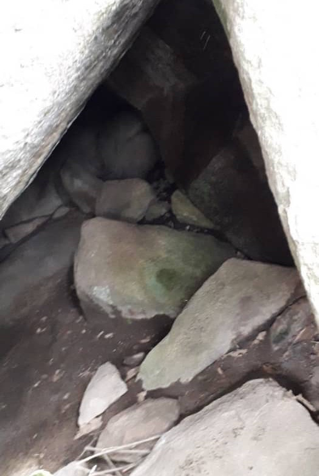
Deeper into the hills, the caves spoke for themselves. Some are wide enough to have sheltered entire families; others narrow to tight passages that would have admitted only crouching bodies. Natural rock ponds provided water. Local accounts describe specific caves used to treat the wounded. Inside, broken clay pots still lie where they were left such as vessels for storing food and water, their purpose obvious even in fragments. Nearby, pieces of iron and steel identified by community custodians as linked to the conflict period sit undisturbed. These are not museum exhibits. They are evidence that the hills were not merely hiding places but living spaces where people struggled to survive.
The most striking moment came near the summit. The chief pointed to dark stains embedded in a rock face and said simply: “It’s the blood of the enemy.” We did not seek to verify this claim scientifically. What mattered was the interpretive act itself — a community that has lived in relationship with this landscape for generations, has named every feature of it, and has decided that this particular mark must be remembered and explained. That is not folklore. That is a form of testimony.
“The Lamogi Hills are not simply monuments to war. They are enduring reminders of the human capacity especially as Africans to resist, adapt, and rebuild.”
As peacebuilders, what struck us most is what this site offers that formal transitional justice mechanisms so often lack: rootedness. Lamogi works from the inside out, a community that has held its own memory, maintained its own archive, and continued to transmit its own account of what happened, on its own terms, without waiting for institutional validation.
Descending the hills, we were left with a question that the AFRIAK fellowship had been quietly building toward all residency: what does it mean to take indigenous knowledge seriously, not as heritage to be preserved behind glass, but as a living system of understanding, tested over generations, embedded in place, and still actively at work? The Lamogi Hills are not a case study. They are an answer.
Daniel Adeola & Nomfundo Kunene, AFRIAK Fellows, Uganda Hub, CODESRIA