
By Maryam Shuaibu
President Bola Tinubu has urged state governors to channel their increased allocations from the Federation Account into road infrastructure instead of constructing flyovers in areas with little traffic, saying better road networks would improve living standards and strengthen security operations.
The president also reiterated his administration’s policy of refusing to negotiate with terrorists or pay ransom for abducted victims, revealing that kidnappers of schoolchildren and teachers in Oyo State demanded the release of detained gang members alongside ransom before their eventual rescue.
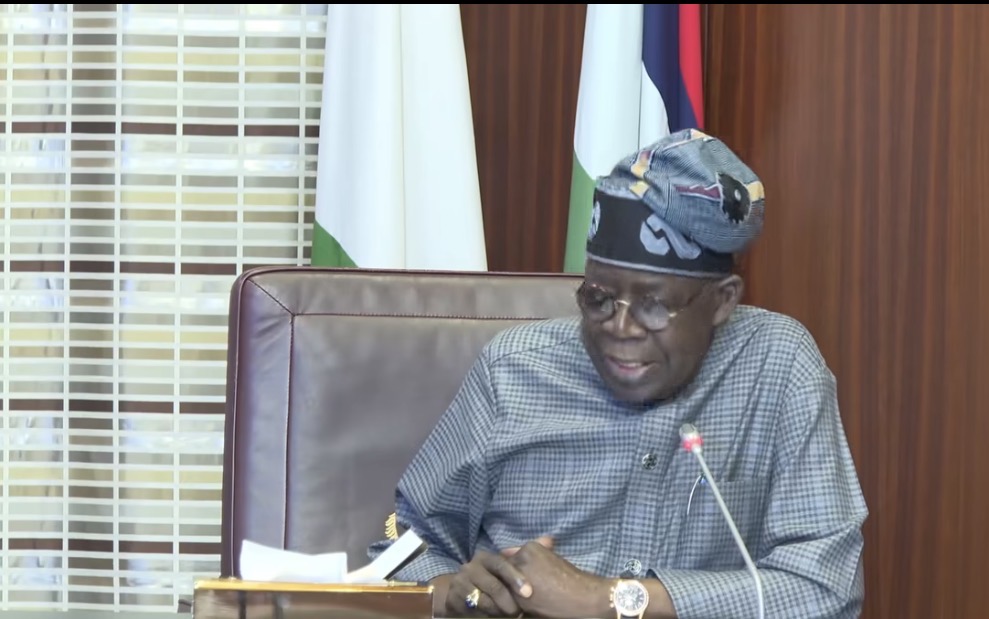
Mr Tinubu spoke on Thursday while receiving a delegation of traditional rulers from Oyo State led by the Olubadan of Ibadanland, Oba Rashidi Ladoja, at the Presidential Villa, Abuja. The monarchs visited to congratulate him on the rescue of abducted pupils and teachers from Oriire Local Government Area after 56 days in captivity.
Addressing the delegation, Tinubu said states now receive significantly higher federal allocations than in previous years and should use the funds to improve critical infrastructure rather than embark on projects with limited public value.
“The cost of operation is high. But the money that I’m pushing to the states, if you had it during your own time, or during my time, it would have been different,” he said.
“They are taking four to five times their money. Nobody is borrowing money to pay salaries now. Pensioners are receiving their pay.
“They should do more instead of building flyovers where there is no traffic; build roads and arterial networks to really enhance the quality of life and enable security agencies to access those areas.”
No negotiation with terrorists
Speaking publicly for the first time on the rescue of the Oriire abductees, Tinubu said his administration rejected the kidnappers’ demands, insisting that government would neither negotiate with criminal groups nor release detained suspects in exchange for hostages.
According to him, the abductors demanded the release of some of their members already in custody in addition to ransom payments.
“We refuse to negotiate for ransom. These criminals wanted us to release from detention members of their criminal gangs that were already arrested. That was one of their conditions, apart from the money they demanded.
“And we said no deal. We are not going to negotiate with criminals.”
He commended the armed forces for the successful rescue operation, describing it as evidence that Nigeria’s security architecture was adapting to emerging threats.
The president disclosed that his directive to expand the Nigerian Army from eight to 12 divisions was informed by lessons from the Oriire abduction and aimed at reducing response time to security emergencies.
“As we emphasise the question of security, each event teaches us new methods and challenges us to re-examine our strategy, our map and operations,” he said.
“We have the geography of the forest. We know what it is, and in response to it, you’ve seen that from eight divisions, we are now moving to 12 divisions to shorten the response time and give our security forces the capacity needed to defeat terrorism and banditry.”
Tinubu also reaffirmed plans to establish state police with safeguards to prevent abuse, saying traditional rulers would play important roles in the new policing structure.
“There will be state police, and that state police will have guardrails against abuse. We will protect it from abuses, and you traditional rulers too will have a role to play.”
Regional insecurity
The president attributed the worsening security situation partly to instability in neighbouring Sahel countries, saying conflicts in Mali, Burkina Faso and Niger Republic have fuelled cross-border criminal activities in Nigeria.
According to him, strengthening forest guards alongside the planned state police system is essential to addressing the evolving security threats.
Nigeria’s security agencies rescued the abducted pupils and teachers from Oriire Local Government Area of Oyo State on 10 July after they spent 56 days in captivity. The incident renewed concerns over school abductions and the broader security challenges facing parts of the country.
The president’s comments also come amid increased allocations to states following fiscal reforms, with the Federal Government repeatedly urging sub-national governments to channel the additional resources into infrastructure and social development projects rather than recurrent expenditure or prestige projects.