
…As Health Commissioner Praises SAPZ’s Nutrition Improvement Programmes
By Mustapha Salisu
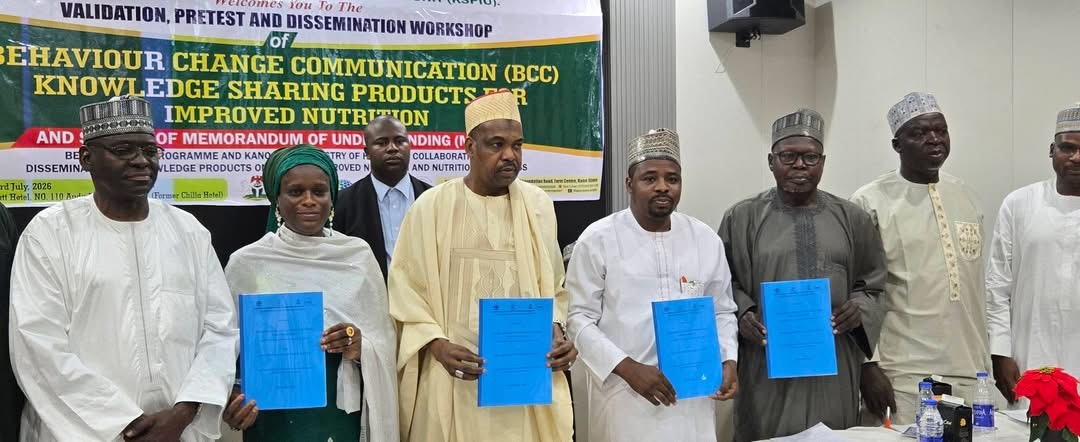
The Special Agro-Industrial Processing Zone (SAPZ) initiative on Thursday, signed a Memorandum of Understanding (MoU) with the Kano State Ministry of Health as a collaborative move to institutionalize effective dissemination of Behaviour Change Communication (BCC) products and the achievement of improved nutrition outcomes across the State.
The historic event which was held at Chilla Hotel in Kano, coincides with the Organization’s 1-Day workshop which seeks to validate and pretest the SAPZ BCC knowledge-sharing products.
Speaking at the workshop, the state’s Commissioner of Health, Dr Abubakar Labaran Yusuf praised SAPZ’s nutritional programmes which seeks to improve the standard of nutrition in Kano state.
He emphasized the importance of antenatal care, postnatal healthcare, exclusive breastfeeding, child nutrition and family planning as essential measures for reducing maternal mortality and malnutrition.
The Commissioner reaffirmed the vital role of farmers in ensuring food security nationwide and recognized the importance of integrating nutrition education into agricultural programmes for farmers to prioritise producing agricultural products that support child nutrition in Kano State.
He encouraged participants to promote balanced and nutritious diets at the household level and to stepdown the knowledge acquired during the workshop within their communities, particularly among women.
Read Also: Nigeria Adopts Domestic Funding Model for Nutrition Programmes – CLOCKWISE REPORTS
Speaking earlier, Hajiya Rabi Mustapha Sadiq, Knowledge Management and Communication (KMC) Officer of the Special Agro-Industrial Processing Zones (SAPZ) Programme, said the workshop was organised to validate and pre-test the programme’s Behaviour Change Communication (BCC) knowledge-sharing products.
She explained that the workshop also served as the official dissemination of the approved nutrition communication materials to stakeholders, while providing an opportunity for nutrition experts and other key stakeholders to offer technical feedback aimed at strengthening the products before their large-scale distribution.
According to her, the workshop was designed to strengthen multi-sectoral collaboration to improve nutrition outcomes across the State and to also
formalise collaboration between the SAPZ Programme and Kano State Ministry of Health through the signing of a Memorandum of Understanding (MoU) for the implementation and dissemination of Behaviour Change Communication interventions.
Rabi noted that the SAPZ Programme recognises that improved agricultural productivity should translate into better nutrition, healthier families and more resilient communities.
She added that through effective BCC, strategic partnerships and evidence-based knowledge sharing, the programme remains committed to promoting healthy diets and nutrition-sensitive agriculture across Kano State.
CLOCKWISE REPORTS gathered that participants of the workshop include officials of the Kano State Ministry of Health, Kano State Ministry of Agriculture and Natural Resources, SAPZ Programme State Programme Implementation Unit (SPIU), Smallholder Farmers, Nutrition Experts and Health Educators.
Others, include Nutrition Focal Persons from the 16 SAPZ participating Local Government Areas, Development partners, Media organizations, and Civil society jorganizations and other relevant stakeholders
This paper reports that, the SAPZ Programme, implemented by the Federal Government of Nigeria (FGN) in partnership with the African Development Bank (AfDB), International Fund for Agricultural Development (IFAD), Islamic Development Bank (IsDB), participating state governments and private investors, is being implemented in Kano, Imo, Kaduna, Cross River, Kwara, Oyo, Ogun States and the Federal Capital Territory in the first phase.
The programme also supports high food production areas to supply domestic food markets, create export surpluses and strengthen the capacities of smallholder farmers, small agro-processors, traders and community-based service providers including women and youth.