
By Zulaiha Danjuma
In August 2025, the Kano State Police Command made an announcement that echoed a significant road safety concern for many Kano citizens.
The Police Public Relations Officer, SP Abdullahi Haruna Kiyawa, said underage tricycle operators were responsible for 16 road crashes in the state in that month alone.

Caption: Kano State Police Command Press Release, August 2025
The statement said the incidents led to injuries and property losses. The Kano Police Command further stated that riding tricycles by underaged persons is prohibited by law and is a cause of danger to the tricyclists and other road users.
It is now July 2026. One year later. There has been no follow-up report from the Federal Road Safety Corps, or new data from the police regarding underaged drivers, nor public awareness campaigns or data of arrests or measures and alternatives taken to curb underage tricycle riding.
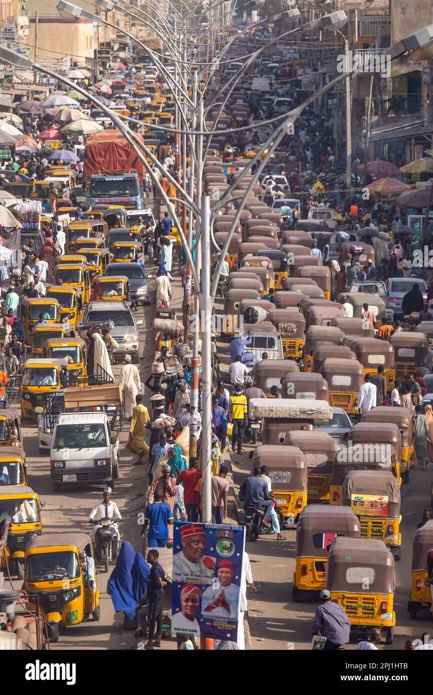
At popular tricycle operator hotspots like Singer Market, Kofar Wambai, Zoo Road Total junction and Bata junction, you can still see boys who look 15 and 16 years old behind tricycle wheels, weaving through traffic. Young men and oftentimes underage boys make up the larger number of tricyclists in Kano state.
This issue goes beyond maintaining law and respecting road safety measures. It goes into systemic economic hardship, lack of formal education and unemployment.
“I ride Adaidaita Sahu to fend for my parents and siblings, as the first son,”
Abba, not his real name, a 16 years old said. Many underaged boys like Abba undertake riding tricycles to help their families financially.
The Education Gap
This is not just a transport problem. It is an education problem. According to UNICEF Nigeria, Nigeria had over 10.2 million out-of-school children as of 2023, with the North-West zone recording the highest rates.
In Kano, many boys drop out to join the Adaidaita Sahu business because there are no other options when schooling halts or comes to an end. For many, the road becomes the classroom, and the tricycle becomes the job.
Kabiru Adamu, a 40-year-old tricyclist who lives in Medile, said many of the underage young boys who enter the business do so as a means to keep their lives going, with some not having formal education to seek other jobs and others having parents and siblings who heavily rely on them.
“We now have a lot of young men who are graduates riding Adaidaita Sahu, because there are no white collar jobs,” he said.
“Then there are the ones who don’t even have formal education and they need to make money to cater to their needs and that of their families,” he explained.
It is not enough to blame the road accidents on underage boys going behind the wheel of tricycles. The issues surrounding lack of education, poverty and unemployment tie directly to road safety.
The Law vs The WHO Warning
Under the Nigeria Highway Code, enforced by the Federal Road Safety Corps, the official minimum age to drive on public roads in Nigeria is 18 years old. For commercial vehicles, a higher class license is required from age 26.
According to the World Health Organization, younger drivers are less capable of recognizing hazards and making split-second decisions due to inexperience. The WHO also states that road traffic injuries are the leading cause of death globally for young people aged 5–29.
The Reality Kano State Lives In
A police warning can only work if people have other options. In Kano, many families do not.
In Kano, that law and that WHO warning run straight into poverty. The 16 crashes flagged in August 2025 by the Kano State Police Command were not just about reckless driving. They were about a system where school is out of reach, jobs are scarce, and an Adaidaita Sahu (Tricycle) is the fastest way to eat.
For many poor and low-income families, when hardship dictates who gets behind the wheel, a press release alone cannot stop it. This is where road safety meets poverty, and this is where WHO standards and Kano’s reality collide.
Why It’s Likely To Continue Happening: Three System Gaps
1. Economic Hardship:
World Bank data shows over 96% of employed Nigerian youths work in the informal sector. With nearly 1 in 4 young people neither in school, employment, nor training, the informal transport sector has become a vital survival mechanism.
The WHO states that drivers aged 15-24 are 3 times more likely to be involved in fatal crashes due to inexperience and risk-taking behavior. For families struggling with costs, putting a 16-year-old on a tricycle means daily income. The risk is considered later.
2. No Enforcement at the Point of Work
According to the National Road Traffic Regulation 2012, a standard private driving license is issued from age 18. Tricyclists and motorcyclists fall under this Class A license.
However, underage boys driving tricycles in Kano typically do not hold legal driving licenses. They often bypass the official process by obtaining operational permits from agencies like Kano State Road Traffic Agency (KAROTA) through vehicle owners or “fixers” who skip age verification.
In Kano, many young boys share turns to drive tricycles to earn a living, even if they do not own one. They lease it from owners or friends with scheduled work times.
In 2025, the FRSC Sector Commander in Borno State, Mr Usman Muhammad, decried the number of underaged commercial drivers in Northern Nigeria.
“The number of minors behind the wheels, including tricycles, motorcycles and even articulated vehicles was alarming,” he said.
Underage tricycle drivers in Kano face multiple WHO risk factors at once: inexperience, speeding, and lack of protective gear. The laws exist on paper. Enforcement on the road remains weak.
3. No Safer Alternative
Kano’s public transport system still relies heavily on tricycles for daily mass commuting. Until there are safer, regulated alternatives, the demand for cheap, fast rides will keep putting underage riders on the road.

Caption: Tricycles at Yan Kura Market, Kano.
What Needs To Be Done
To limit the risk of underaged tricyclists leading to road crashes, the issue must look beyond traffic arrests and tackle the poverty driving underaged boys onto the roads.
1. Accurate Age Verifications: Vehicle Inspection Officers (VIO), FRSC and KAROTA should partner with tricycle union officials and private owners, to enforce a No ID showing 18+, no tricycle lease.
2. Owner Accountability: Shift punishment to adult owners. Heavily fine or impound vehicles leased to minors.
3. Link Road Safety Data to Social Protection: Road safety enforcement should be linked to poverty programs. FRSC and the Ministry of Humanitarian Affairs should share data. Families of intercepted underage riders should be automatically enrolled in state cash transfer or skills programs. Safety cannot be enforced while ignoring hunger.
4. Paid Skills + Schooling: Creation of part-time vocational programs with stipends and feeding for out-of-school youths and Almajirai, so families do not lose income during training.
The Kano Police Command gave us a number in August 2025: 16 crashes. One year later in July 2026, we do not have a new number. But we still have the same boys on tricycles. We still have the same risks. A warning without action is not a solution. It is just waiting for the next crash