
By Mustapha Salisu
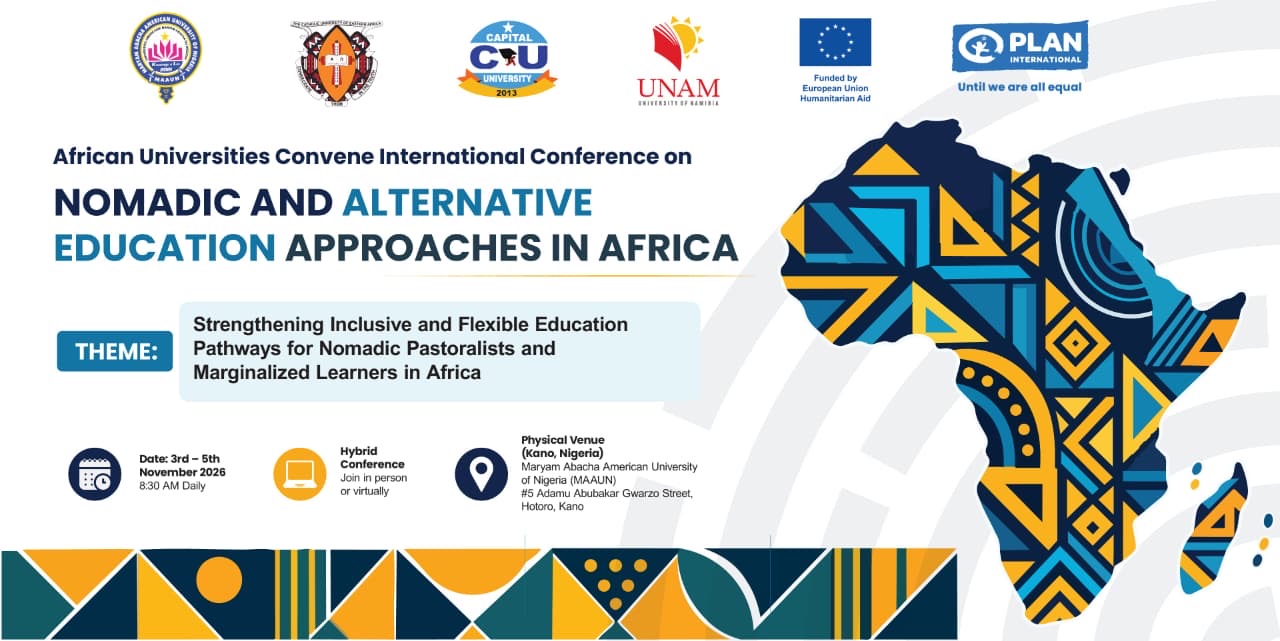
Maryam Abacha American University of Nigeria (MAAUN) and three other African universities, in collaboration with Plan International Nigeria, will convene a three-day international conference on nomadic and alternative education from November 3 to 5, 2026.
The conference will be held in a hybrid format across four locations: Kano, Nigeria; Mogadishu, Somalia; Nairobi, Kenya; and Windhoek, Namibia.
Other participating institutions are Capital University of Somalia, the Catholic University of Eastern Africa in Kenya, and the University of Namibia.
The event will bring together researchers, educators, policymakers, government agencies, development partners, civil society organisations, community leaders and representatives of nomadic and marginalised communities to examine barriers to education and explore practical approaches to inclusive learning.
Organisers said conventional schooling systems often fail to accommodate the realities of mobile, nomadic, displaced and remote communities, whose access to education is affected by distance, seasonal migration, livelihoods, language barriers and cultural practices.
They noted that these challenges contribute to irregular school attendance, low enrolment and retention, disrupted learning and limited opportunities for further education and skills development.
Conference to Examine Flexible Education Models and Policy Reforms
The three-day conference will focus on strengthening policy dialogue, sharing research and practical experiences, and identifying sustainable ways to integrate flexible education models into national education systems.
Discussions will cover 14 thematic areas, including education policies and legal frameworks, pastoralism and cultural practices, sustainable financing, mobile learning, teacher recruitment and support, language and community engagement, digital education, gender and disability inclusion.
Read Also: NMCN Inducts 111 Pioneer Nursing Graduates of MAAUN Kano
Other areas include education for displaced and migrant populations, learning in conflict and emergency situations, and the relationship between education, skills acquisition and livelihoods.
The programme will feature an opening ceremony, policy discussions, keynote addresses, research presentations, technical sessions and panel discussions. Partnership engagements and a closing ceremony are also scheduled.
MAAUN: Conference Seeks Continental Collaboration on Nomadic Education
Among the expected outcomes are policy recommendations on improving access to quality education for nomadic and other marginalised populations, as well as identifying financing options and strategies for expanding effective alternative education models.
The conference is also expected to produce a communiqué or proceedings and contribute to the proposed establishment of a continental network for research and practice on nomadic and alternative education.
Organisers said stronger collaboration among governments, universities, communities, civil society groups and development partners would be necessary to ensure that flexible education programmes are inclusive, sustainable and connected to national education systems.
They stressed that alternative education should not remain a temporary or parallel arrangement but should provide recognised and continuous learning pathways for children and young people whose circumstances make conventional schooling difficult.
The conference will also examine how gender, disability, displacement and insecurity compound educational exclusion, with emphasis on community participation, trained teachers, responsive policies and sustainable funding.
Media coverage of the event is expected to include interviews with researchers, policymakers and practitioners, as well as discussions on government ownership, education financing and the experiences of affected communities.
The organisers have urged media representatives to observe safeguarding and ethical reporting standards, particularly when covering children, adolescents and other vulnerable participants. Photography, filming and interviews involving participants will require coordination with authorised Plan International staff and compliance with its consent and safeguarding procedures.