
By Colins Ezra
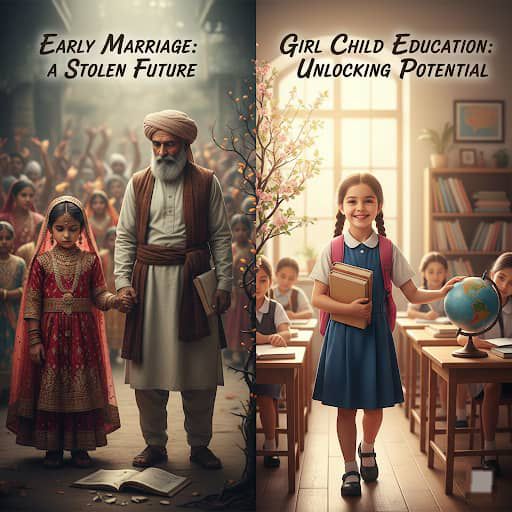
Early marriage remains one of the most serious threats to girl-child education, particularly in developing countries like Nigeria. It is a deeply rooted social practice that affects millions of girls, cutting short their education and denying them the opportunity to reach their full potential. This article seeks to explore the connection between early marriage and the girl-child’s right to education, emphasizing the urgent need for change in societal norms and policies.
When a girl is married off early, her education is almost always the first sacrifice. The responsibilities that come with marriage housekeeping, childbearing, and caring for a family become obstacles that prevent her from continuing her schooling. Her dreams are often put on hold indefinitely or lost entirely, reducing her chances of building a better future for herself and her community.
Cultural and societal expectations play a major role in sustaining early marriage. In some communities, it is seen as a way to preserve a girl’s honor or protect her from immoral influences. However, these intentions, though sometimes well-meaning, cause more harm than good. They limit the girl’s development and restrict her right to make choices about her own life.
Read: Rule of law central to Nigeria’s progress – NBA Ungogo chair
Poverty is another significant factor that fuels early marriage. In low-income families, daughters may be seen as financial burdens. Marrying them off at a young age reduces household expenses or brings in dowry payments. But what seems like a short-term solution creates long-term consequences, as uneducated women are less likely to earn income, perpetuating the cycle of poverty.
Early marriage also has serious health implications. Young girls are often not physically or emotionally prepared for pregnancy and childbirth, leading to complications that can result in death or long-term health issues. Emotionally, these girls are forced to grow up too quickly, often facing trauma, abuse, and depression.
Beyond the physical and emotional toll, early marriage violates fundamental human rights. It denies girls the right to education, freedom, and personal development. It is a form of gender-based violence that must be addressed with urgency and empathy.
Read Also: Youth O’Clock Nigeria Trains 200 Uniformed Organizations in Gombe
Education, on the other hand, is a powerful tool that can transform the life of a girl. An educated girl is more likely to delay marriage, have healthier children, participate in the workforce, and contribute to national development. Education gives girls the voice and confidence to make informed decisions about their future.
Keeping girls in school helps build stronger economies. Studies show that each additional year a girl spends in school increases her future income. Educated women invest more in their families and communities, creating a ripple effect of progress.
Changing the narrative around early marriage requires active involvement from the community. Religious leaders, parents, traditional rulers, and youth groups must be engaged in conversations that challenge harmful traditions and promote the value of education.
The government has a critical role to play. It must enforce laws that prohibit marriage under the age of 18 and ensure that girls have access to free, quality education. Legislation alone is not enough it must be supported by public awareness, financial investment, and community-based programs.
Media and civil society organizations also have a duty to amplify the voices of affected girls and highlight the benefits of keeping them in school. Powerful storytelling and advocacy campaigns can shift public perception and influence policy changes.
Support structures must be created to protect vulnerable girls. This includes scholarships, mentorship programs, safe spaces, and school feeding initiatives. These interventions make it easier for families to choose education over early marriage.
Read Also: Your Guide to Higher Education in Kano: Discover Top Universities in the State
It is equally important to celebrate success stories. When communities see girls who have stayed in school and gone on to achieve great things, it challenges stereotypes and inspires hope. These stories become a powerful reminder of what is possible when girls are given a chance.
In many places, education for girls stops at the primary level. However, it is at the secondary and tertiary levels that the real impact is seen. Efforts must be made to ensure that girls not only start school but complete it.
Early marriage and girl-child education are deeply intertwined. To secure a brighter future for girls and for our society as a whole, we must break the cycle of early marriage by investing in education, changing harmful cultural norms, and holding institutions accountable. Every girl deserves the right to learn, grow, and thrive and we all have a role to play in making that possible.