
By Amina Rabiu Bako
Before sunrise in Kano, Abdullahi Adamu already knows how his working day will be shaped.
“It depends on fuel,” he says, adjusting his motorcycle before picking up his first passenger. “If I don’t spend half my money on fuel, I can work. But if I work, I still end up spending it.”
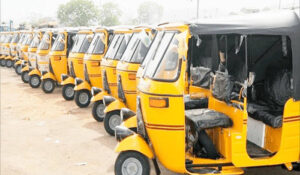
His experience reflects a wider reality captured in a recent study conducted by Carbon Assets Limited, which examined informal transport systems across Northern Nigeria. The research highlights how rising fuel costs are not only increasing operational pressure but also reshaping livelihoods and accelerating interest in alternative mobility systems such as electric transport.
Fuel Costs and a Struggling Informal Economy
The study by Carbon Assets Limited, led by its Chief Executive Officer Mukhtar Abdulhameed, shows a transport system under severe economic strain across Kano, Kaduna, and Jigawa states, with technical support from the PACE Programme (Partnership for Agile Governance and Climate Engagement, supported by UK International Development).
Findings indicate that fuel now accounts for 66 to 73 per cent of operators’ earnings, leaving little room for profit, savings, or reinvestment.
Since 2023, following fuel price increases, between 97 and 99 per cent of operators reported reduced incomes, with many saying they now work primarily to sustain fuel consumption rather than generate profit.
In some cases, operators spend more on fuel daily than they earn.
“We used to think about saving,” Yusuf Abubakar, a tricycle operator in Kaduna says. “Now it is just fuel first. Everything else comes after.”
The findings illustrate how fuel dependency has shifted informal transport from a livelihood system into a survival cycle.
Electric Mobility and Digital Readiness
Despite the pressure, the study reveals an unexpected openness to change.
Between 94 and 98 per cent of operators expressed willingness to adopt Battery-as-a-Service (BaaS), a model that allows users to swap batteries instead of purchasing fuel.
Operators currently spending about ₦9,600 daily on fuel could reduce costs to approximately ₦4,000 per day under this system, depending on usage patterns.
Beyond cost savings, the interest reflects growing fatigue with fuel instability and a search for more predictable income systems.
The study also shows that 97 to 99 per cent of operators already use mobile money platforms, suggesting that the sector is already digitally prepared for structured payment systems that electric mobility would require.
Trust, Unions, and the Future of Transport
However, adoption is not without concerns. Between 77 and 85 per cent of operators identified battery failure as their main fear, stressing that breakdowns could mean a complete loss of daily income.
For workers whose earnings depend entirely on daily movement, reliability is not a technical feature—it is survival.
“If the battery stops on the road, my day is finished,” another operator says. “There is no backup.”
The study also highlights the influence of transport unions in shaping adoption decisions. Between 90 and 99 per cent of operators said they would adopt electric mobility if endorsed by their unions, positioning these groups as critical trust anchors in the sector.
Ultimately, the findings suggest that the success of any transition will depend less on technology availability and more on communication, trust-building, and institutional endorsement.
What emerges from the Carbon Assets Limited study is a sector under pressure but not resistant to change.
Rising fuel costs are pushing informal transport workers into increasingly fragile economic conditions, while simultaneously opening space for electric mobility solutions supported by digital infrastructure and strong operator interest.
Yet between crisis and transition lies a critical gap: trust.
For operators like Abdullahi Adamu, the future is not defined by policy documents or projections, but by a simple demand:
“Something that works every day.”