
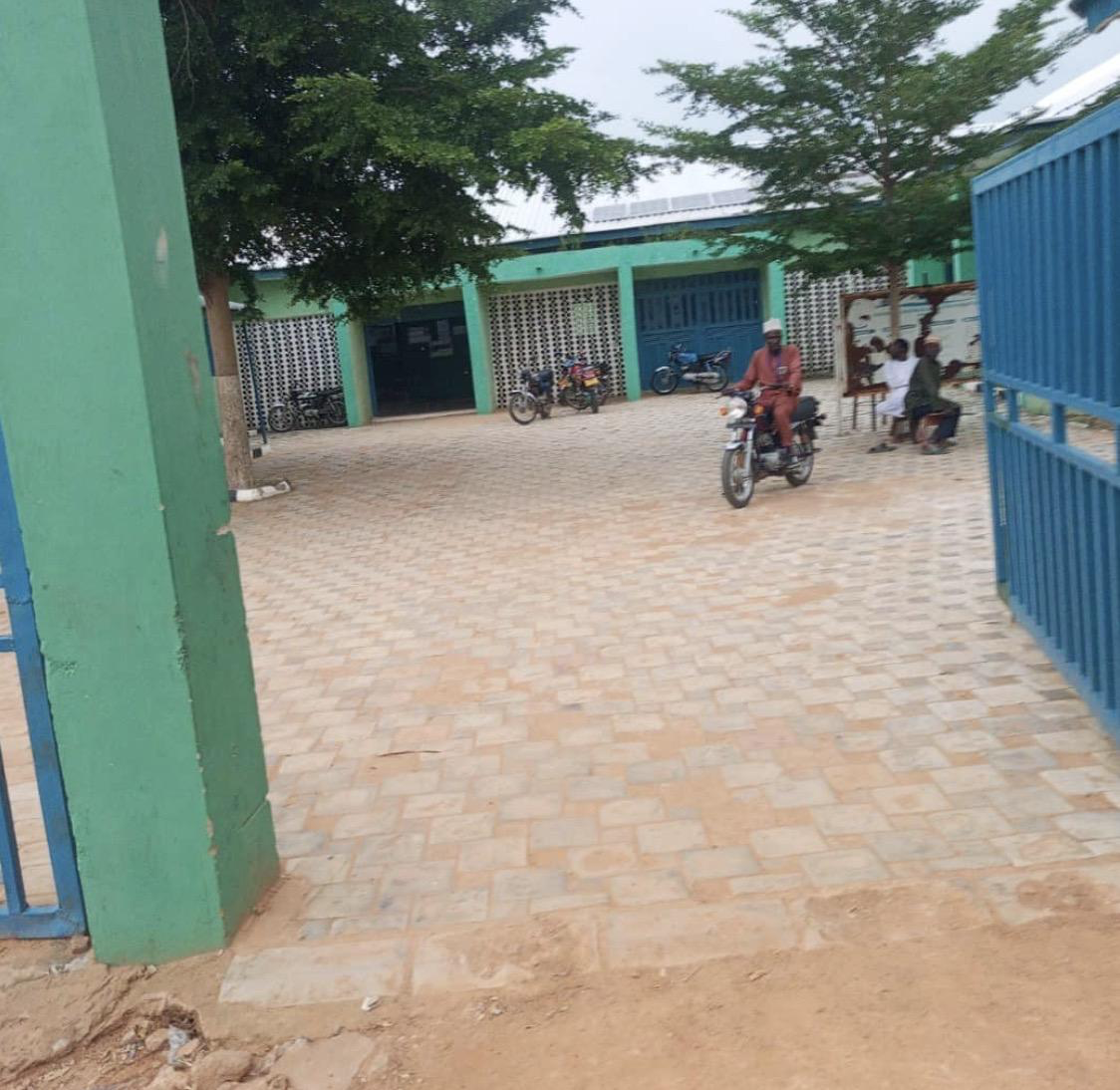
Across Kano State, remote communities depend on primary health centres for essential care, but unreliable electricity continues to undermine services. At Kore, health workers say inadequate solar power leaves the facility vulnerable to outages, particularly when patients need care at night.
By Mariya Shuaibu Suleiman
Despite government plans and millions of naira earmarked for upgrading Kore PHC, the facility remains dependent on a solar system that health workers say cannot provide electricity throughout the day and night. The gap between investment in the facility and the basic power needed to sustain its 24-hour services raises questions about whether infrastructure upgrades are keeping pace with the needs of rural healthcare delivery. In this investigation, Mariya Shuaibu Suleiman exposes the reality behind the government’s investment plans and what unreliable power means for patients at Kore PHC.
———
KORE, Kano — When Shafiu Lawan Hassan reports for duty at Kore Model Primary Health Centre in Danbatta Local Government Area of Kano State, he knows that the health workers are expected to be available to patients around the clock.
The facility operates 24 hours a day, including weekends, serving residents of Kore and surrounding communities.
But there is one problem that Mr Hassan says repeatedly limits what the facility can do: electricity.
The health centre has no connection to the national electricity grid. Its only source of power is a solar installation, but the system does not have enough panels to meet the facility’s needs.
According to Mr Hassan, the solar power lasts for no more than about four hours.
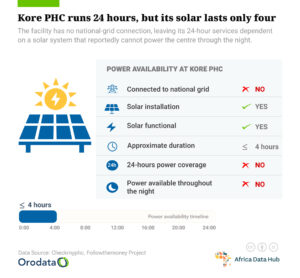
For a facility expected to provide healthcare throughout the day and night, the limitation becomes more serious after sunset, when the centre still has to attend to patients, including women who arrive in labour.
Mr Hassan said one of the biggest concerns is what happens when a woman is giving birth at night and the solar power has already run out.
He said health workers cannot predict how long the available power will last, particularly when labour begins late in the day and continues into the night.
“If a woman comes to deliver at night and the solar goes off, the delivery area becomes dark,” he said. “You cannot know when the solar will go off because it does not last for the whole night.”
The problem, he said, creates uncertainty for workers who are expected to provide continuous maternal care.
Kore Model Primary Health Centre is about 98 kilometres from Kano city, meaning that patients who require services unavailable or difficult to provide at the facility may have to travel a considerable distance for care.
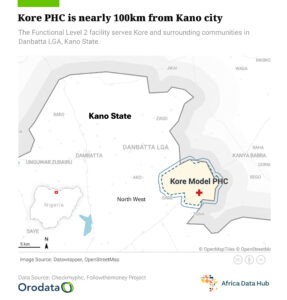
The problem is not that the facility has no solar panels at all. Rather, the existing system, according to the officer in charge, does not provide enough power or last long enough to support the health centre throughout the day.
The electricity problem is occurring even as the health centre is undergoing renovation under the IMPACT Project 2025, a World Bank-supported intervention being implemented to improve health facilities. Work at Kore Model Primary Health Centre includes renovation of the facility, but the intervention has not changed the health centre’s dependence on its existing solar power system, according to the account of the officer in charge. The facility still has no connection to the national electricity grid.
 Signboard of Kore Model Primary Health Centre. (PHOTO CREDIT: Mariya Shuaibu Suleiman)
A PHC expected to provide 24-hour care
The concern is not simply about whether the health centre has electricity.
It is about whether the facility has enough reliable power to provide the services it is expected to offer at all hours.
The National Primary Health Care Development Agency (NPHCDA) PHC revitalisation framework sets requirements for Functional Level 2 primary healthcare centres, including reliable electricity, backup solar power, water, sanitation and hygiene facilities and infrastructure for continuous services.
Kore Primary Health Centre is listed as a Functional Level 2facility in a 2026 national health facility dataset.
The NPHCDA’s Priority PHC Initiative also requires functional PHCs to have regular electricity and the capacity to provide uninterrupted 24-hour services, including safe deliveries.
A 2015 study of 80 health facilities in Bauchi and Sokoto states found that inadequate electricity affected maternal healthcare at night. The study, published in BMC Pregnancy and Childbirthand led by Olugbenga Oguntunde, found that only 30 per cent of healthcare providers reported adequate lighting at night, while facility managers said power outages sometimes forced health workers to rely on torchlights, rechargeable lamps and mobile-phone lights. One facility manager reported using a rechargeable lamp or mobile-phone light during a midnight delivery because the facility had no generator. The researchers identified inconsistent electricity supply as a barrier to providing maternal health services at night.
The World Health Organisation (WHO) has also identified electricity as essential to healthcare, including lighting, clean water, safe childbirth, vaccination, diagnostics and emergency response. In April 2026, WHO reported that an estimated 40–50 per cent of primary healthcare facilities in Nigeria experience unreliable electricity.
Patients feel the gap
For women who depend on Kore Model Primary Health Centre for maternal care, the electricity problem becomes more worrying when labour starts at night.
Safiya Ismail, a patient at the health centre, said the uncertainty over electricity could discourage women from seeking care at the facility, particularly at night when they need immediate assistance during labour.
“If a woman starts labour at night and there is no light, how will she get the help she needs?” Mrs Ismail said.
She said the possibility of arriving at a health facility and finding it without adequate electricity could make some women reluctant to seek care, particularly when they could otherwise choose to remain at home.
The issue also affects men.
For Tukur Muhammed, the problem became personal when his child fell ill at night and he took the child to Kore health centre for treatment.
Mr Muhammed said the facility was dark when they arrived, forcing the health worker on duty to use a torchlight to examine the child, including checking the child’s blood pressure and temperature.
He said the lack of adequate lighting made the examination more difficult and meant they had to spend longer at the facility before the child could receive attention.
 Inside view of Kore Model Primary Health Centre. (PHOTO CREDIT: Mariya Shuaibu Suleiman)
Mr Hassan said the facility continues to receive women who go into labour at night, even when the solar power has run out. He said health workers have had to use torchlights to attend to patients and continue conducting deliveries when the facility is without electricity.
The concern is not limited to the difficulty of seeing during a night-time delivery. Joseph Akinde, an obstetrician-gynaecologist, said adequate electricity and water were essential for safe healthcare delivery.
He said proper lighting was particularly important during childbirth because it enables health workers to identify and repair tears that may occur after delivery.
Government has budgeted for Kore, but power remains a problem
Kano State’s budget documents show that Kore PHC has been the subject of government investment plans.
The state’s approved 2025 budget allocated ₦111.706 millionfor the “Upgrading of Kore PHC to Cottage Hospital in Dambatta LGA.” The allocation was listed under rehabilitation and repairs of hospitals and health centres.
The 2026 approved Kano State budget also contains a ₦105 million allocation for a grouped project titled “Upgrading of Madachi PHC in Rano, Rogo PHC, Kore PHC in Danbatta, Kaura Goje and Gama PHC in Nasarawa LGA to Cottage Hospital.”
These allocations show that Kore has appeared in the state’s capital spending plans, but a budget allocation alone does not establish how much money has actually been released or spent, what work has been completed or whether the electricity problem has been addressed.
Kano State has also continued to invest in primary healthcare infrastructure.
But renovation of the physical structure does not necessarily resolve the operational requirements of a 24-hour health facility. A facility can have its building repaired while still lacking the electricity, water, equipment or staffing required to provide continuous services.
At Kore, the building is receiving attention, but the facility remains dependent on a solar system that Mr Hassan says cannot provide power throughout the day and night.
Solar power is expanding, but capacity and maintenance matter
Across Nigeria, solar power is increasingly being used to address the electricity gap in health facilities.
In March 2026, the Federal Government and development partners solarised 371 PHCs across 16 states and the Federal Capital Territory.
The project, supported by Gavi and UNICEF, was designed to improve healthcare delivery, particularly in underserved communities.
Kano has also benefited from health-facility solarisation.
Gavi reported that solar installations at PHCs in Kano had improved services, including lighting and vaccine refrigeration.
These interventions show that solar energy can help address power shortages in health facilities. But Kore facility illustrates another part of the problem: having solar panels is not necessarily the same as having reliable electricity.
The capacity of the system, battery storage, the facility’s electricity demand, maintenance and the condition of the equipment all determine how long electricity remains available.
A solar system that provides power for only a few hours may therefore leave the most critical period of service, the night inadequately covered at a facility operating around the clock.
A 2026 WHO report on Rumuigbo Primary Health Centre in Rivers State showed the potential difference reliable solar power can make. After a solar system with battery storage was installed, the facility reported uninterrupted services and an increase in night-time deliveries, while service interruptions fell by more than 80 per cent.
The Federal Government has also acknowledged the broader electricity gap in health facilities.
In August 2026, the Minister of State for Health and Social Welfare, Dr Iziaq Salako, said about 40 per cent of functional PHCs have no electricity, while most of the remaining facilities receive only six to 10 hours of power daily. He said the government was targeting steady power in at least one-third of health facilities by the end of 2027 and stressed the need for proper management and maintenance of renewable-energy systems.
Essential equipment and staffing are another concern
Electricity is not the only challenge facing Kore Model Primary Health Centre. The facility also lacks some essential equipment and does not have enough health workers to meet its needs.
Mr Hassan said the health centre does not have a doctor and has inadequate personnel to provide services consistently, particularly at a facility expected to operate 24 hours a day.
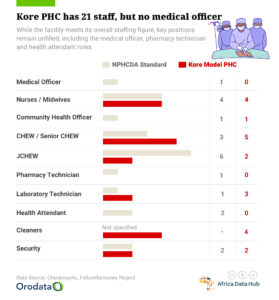
He also identified shortages of essential equipment, including beds, as another challenge affecting the facility’s ability to provide care.
The NPHCDA requirements for functional primary healthcare centres also provide for adequately skilled health workers, essential equipment and other basic requirements needed to deliver healthcare services effectively.
A question of what “24 hours” means
At Kore Model Primary Health Centre, operating for 24 hours is more than keeping the facility open. It requires reliable electricity and other basic infrastructure that allow health workers to provide care throughout the day and night.
With Kore included in Kano State’s plans to upgrade the PHC to a cottage hospital, questions remain about whether the ongoing work is addressing the facility’s electricity needs.
The questions include whether electricity infrastructure is part of the planned upgrade, whether funds allocated to the project have been released and spent, whether the existing solar system has been assessed for capacity, and whether Kore is included in any wider solarisation programme.
According to Mr Hassan, reliable electricity would allow health workers to focus on treating patients without worrying about when the available power will run out.
“For a health centre nearly 100 kilometres from Kano city, dependable electricity would make a significant difference to the facility and the people who depend on it,” Mr Hassan said.
This story was produced for the Follow the money Investigative Program and supported by the Africa Data Hub and Orodata Science.