
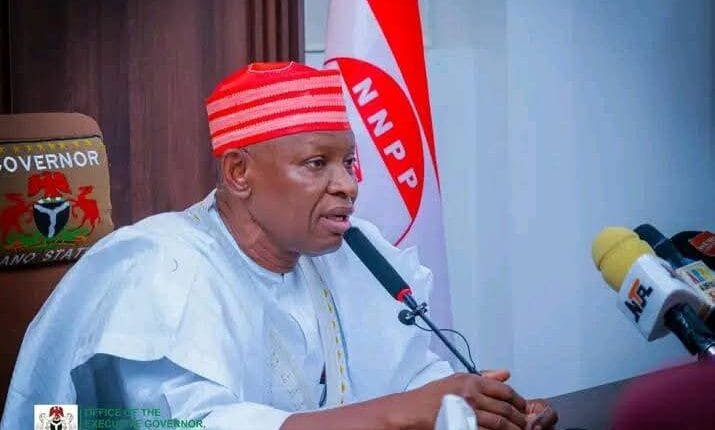
Kano State Governor, Alhaji Abba Kabir Yusuf, has reaffirmed his administration’s zero-tolerance stance against corruption, calling on young people to actively join the fight in shaping a more transparent and prosperous future for the state.
The governor made this known on Tuesday during a commemoration lecture marking the 2025 International Anti-Corruption Day, organized by the Kano State Public Complaints and Anti-Corruption Commission.
Governor Yusuf, who was represented by the Secretary to the State Government (SSG), Umar Farouk, said the theme of this year’s event – “Uniting with Youth Against Corruption: Shaping Tomorrow’s Integrity”—aligns strongly with the values and direction of his administration.
Read Also: How terrorist leader, Abubakar Abba, was arrested – Niger
He noted that his inability to personally attend was due to official engagements in Abuja and Lagos, but assured participants that he was “with them in spirit” and fully committed to the cause.
According to him, the day’s commemoration was not merely ceremonial but a renewed declaration against a “menace that undermines development, threatens the future of generations and betrays the trust of citizens.”
Governor Yusuf emphasized that his administration came into office to rebuild a system weakened by corruption and not to preside over its continuation. “Let my words be clear and without ambiguity: this government maintains a strict policy of zero tolerance for any form of corruption,” he stated.
A key demonstration of this commitment, he said, was the restoration of full independence and operational autonomy of the Kano State Public Complaints and Anti-Corruption Commission. He explained that merit-based appointments and strengthened institutional structures remain central to ensuring accountability.
Read Also: How Late Abba Kyari Frustrated Me – Femi Adesina
Clockwisereports reports that the governor highlighted ongoing capacity-building programmes for political appointees and senior civil servants, saying such trainings on transparency and prudent resource management were designed to institutionalize ethical leadership across public service.
He listed achievements tied to the protection of public resources, including recovery of encroached lands and assets, state of emergency declared in the education sector, revival of health insurance, payment of backlog of pensions and gratuities, and renewed investments in agriculture, healthcare and infrastructure.
Governor Yusuf described young people as central to sustaining the anti-corruption vision, noting that nearly half of Kano’s population falls under the age of 30. He called them “digital pilgrims” capable of using innovation and technology to demand accountability and expose wrongdoing.
“Our youth are not only victims of a corrupt system; they are change agents,” he said, urging them to raise awareness, influence society positively and challenge harmful practices.
He assured that the administration would continue to protect whistleblowers, strengthen weakened institutions and ensure that every public fund is utilized for the people’s benefit.
“The people of Kano are watching. They are tired of promises; they demand action and deserve results,” the governor added.
Read Also:FIDAC Condemns Alleged Unlawful Arrest of Former Kano Anti-Corruption Boss
He called on government officials, civil society groups, youth organisations, private sector players and security agencies to align as partners in building “a just, equitable and corruption-free Kano.”
On his part, the Chairman of the Kano State Public Complaints and Anti-Corruption Commission (PCACC), Saidu Yahya, described the day as memorable for the commission, noting its renewed effort to collaborate with young people in the fight against corruption.
He said the commission recognises that it cannot effectively achieve its mandate alone, hence the need to work closely with all stakeholders, particularly the youth who he described as “the future of tomorrow,” and also the most affected by the consequences of corruption.
“After assuming office in August 2025, I made efforts to strengthen the operational capacity of the commission based on my 18 years of experience with ICPC as an operative. I have been introducing operational methodologies and approaches used at the federal level to enhance our work because ordinarily, a state agency cannot be compared with a federal one. The idea is to bring PCACC closer to the standard of ICPC,” he stated.
Yahya explained that although the introduction of reforms usually attracts resistance, he adopted a diplomatic approach by implementing changes gradually. According to him, this made internal challenges minimal.
He cited the case of a private university in Kano, which PCACC intervened in after receiving petitions from parents. According to him, the commission treats complaints from all parties, whether private individuals or public institutions.
Yahya revealed that before receiving the recent complaint involving a graduating student of Maryam Abacha American University of Nigeria, the commission had handled another case involving a well-known private school in Kano. He said the school had complained that some parents withdrew their children while still owing fees, noting that PCACC investigated and began recovering the outstanding payments.
“The school is Sweethaven School in Kano. The authorities lodged the complaint and we intervened. So far, we have recovered some of the outstanding payments and returned them to the school,” Yahya said.
He added that in the current matter, parents petitioned the commission against the university and that investigations had commenced. He lamented that despite directives issued to the institution to stop demanding ₦750,000 from graduating students before releasing certificates and transcripts, the school allegedly continued to collect the money.
“What we are saying is that even if the school insists that the amount is ₦10 million, that is not our main concern. What concerns us is tying the payment to the issuance of certificates and transcripts. If it becomes optional, then even if it is higher or lower than ₦750,000, we can discuss it. But if any student is victimized for not paying, the commission will not take it lightly,” he warned.
In her remark, the Chief Judge of Kano State, Justice Dije Aboki, represented by Justice Jamilu Yusha’u, conveyed the goodwill message of the judiciary to the symposium.
He recalled the American Declaration of Independence, noting that the rights to life, liberty, and the pursuit of happiness cannot be realised where corruption persists. He quoted former U.S. President Thomas Jefferson, who said that the Tree of Liberty must, from time to time, be refreshed by the actions of patriots.
He stressed that the fight against corruption requires sacrifice, determination, and sustained commitment.
“The judiciary is ready to collaborate with both the executive and legislative arms in combating corruption,” he said.
He expressed hope that young participants at the event would, by the end of the symposium, be better prepared to lead societal transformation and champion integrity in public service.