
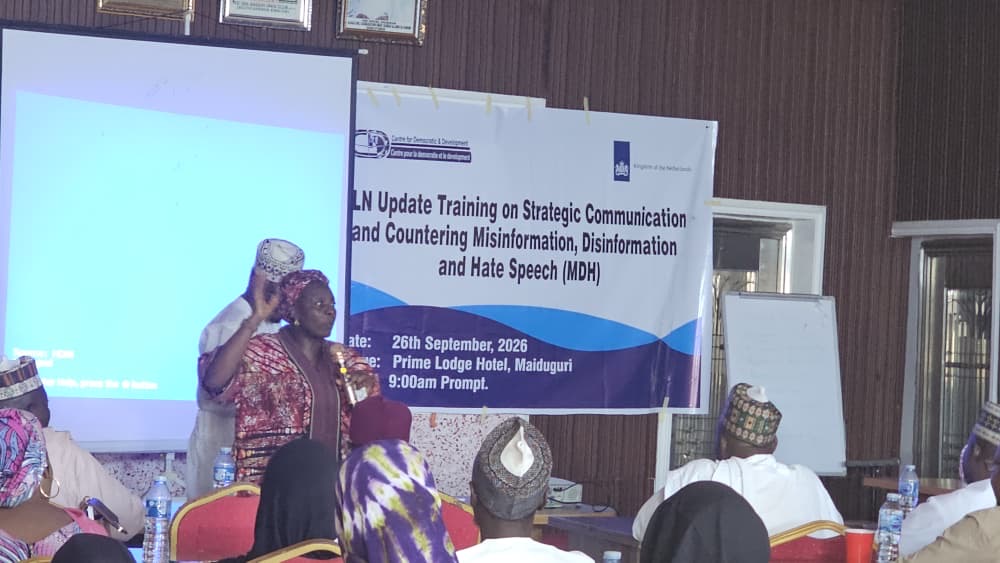
Garkuwan Labarai Network members from MMC, Jere and Konduga learn verification, fact-checking and deepfake detection ahead of 2027 polls.
The Centre for Democracy and Development (CDD) has trained 72 members of its Garkuwan Labarai Network (GLN) in Borno State in fact-checking, verification and the detection of AI-generated deepfakes, reinforcing a grassroots shield against misinformation, disinformation and hate speech (MDH) ahead of the 2027 general elections.
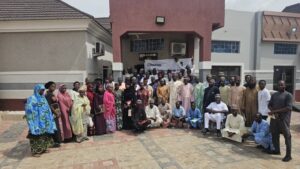
The update training on Strategic Communication and Countering MDH, held on Saturday at Prime Lodge, Maiduguri, drew 24 participants from each of the project’s three local government areas: Maiduguri Metropolitan Council (MMC), Jere and Konduga.
It forms part of CDD’s Netherlands-supported project on strengthening community resilience against disinformation and hate speech for peacebuilding and conflict resolution.
The CDD team was led by its Head of Programmes, Mary Okpe, supported by the organisation’s Borno State Technical Lead, Mohammed Dahiru Lawal.
Participants were taken through human and technical verification methods, fact-checking techniques, strategic communication and practical ways of detecting AI-generated deepfakes, skills designed to help the network monitor, detect, pre-bunk and debunk harmful content before it spreads in their communities.
Okpe said the training was meant to turn the network into a first line of defence for the communities it serves. “The GLN members are the people communities already trust. When rumour starts in the market etc GLN are the closest to the other community members and can be instrumental in debunking or countering the negative narrative before it escalates or leads to violence,” she said.
“Our job is to make sure the GLN also have the tools to check it, to respond to it strategically and to stop it before it becomes a crisis. That is how information integrity becomes peace on the ground.”
Lawal said the network had been deliberately built to reflect the diversity of Borno. “The people in this room are traditional leaders, religious scholars, women, youth, students, journalists, security and emergency responders and grassroots politicians,” he said.
“Misinformation does not respect any of those boundaries, so the response cannot either.”
A councillor representing Mairi Ward in Jere Local Government Area, Ibrahim Saad, commended CDD for assembling what he described as a diverse calibre of people that reflects inclusive representation of the entire state.
Read Also: CDD Tackles Information Disorder in Borno Peacebuilding Effort
Professor Yahuza Ibrahim of the Department of Islamic Studies, University of Maiduguri, a member of the network, said his key takeaway was that information integrity is the most essential component of peace. He warned that a single false report, a bitter rumour or an act of hate speech could ignite a bomb capable of displacing and destroying communities, and thanked CDD for equipping him with the skills to confront what he called a rising threat.
Representing the Independent National Electoral Commission (INEC), Dr Ibrahim Shettima said the training could not have come at a better time, particularly in the build-up to the 2027 elections, when misinformation could trigger election-related crises.
The representative of the Borno State Police Command’s spokesperson, ASP Nahum Kenneth Daso, outlined the command’s work on information verification and crisis communication and shared a public phone line that GLN members can call to have the police verify information circulating in their communities.
Pastor Olabode Yuhana of the EYN Church, Jere, underscored the role of religious bodies in preventing and mitigating crises fuelled by false information and hate speech.
Participants, drawn from traditional institutions, religious bodies, youth and women’s groups, student associations, community-based organisations, grassroots politics, the media, social media influencers, and security, response and emergency agencies, commended CDD for the initiative. They pledged to apply the knowledge gained to strengthen the network’s work of monitoring, detecting, pre-bunking and debunking MDH in their communities and building lasting peace in Borno.
The training follows a series of stakeholder engagements CDD held with INEC, the National Orientation Agency, the Police, the Nigerian Correctional Service, the State Emergency Management Agency, the Nigeria Union of Journalists and traditional institutions in the state.