
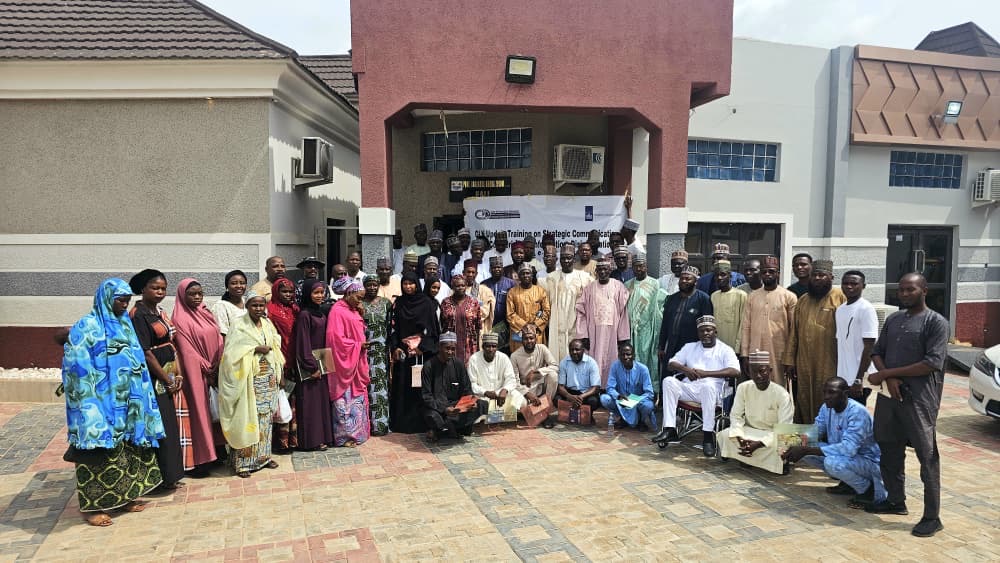
From grassroots neighborhood information guards, to critical institutions, the Centre for Democracy and Development is building a community-wide shield against the misinformation, disinformation and hate speech that have long fed conflict in Nigeria’s North-East
By Mohammed Dahiru Lawal
The Centre for Democracy and Development (CDD) is building a wall of trust against information disorder in Borno State, rallying grassroots communities, security and response agencies, the electoral commission, traditional rulers, and journalists to forge grassroots information monitoring, detection and debunking mechanism for tackling conflict in the North East.
The Garkuwan Labarai Network (GLN) is poised to utilise its diverse composition to contain the misinformation, disinformation and hate speech (MDH) that have so often travelled ahead of violence in a region where one false message has been known to empty a market or ignite a mob.
For nearly two decades, Borno has been the epicentre of an insurgency that has killed tens of thousands and displaced millions across Nigeria’s North-East. Much of the attention, and much of the money, has understandably gone to the visible machinery of conflict such as soldiers, checkpoints, displacement camps and reconstruction.
“Far less has gone to the invisible current running beneath it all, the rumours, doctored videos and ethnic and religious slurs that travel faster than any convoy and very often arrive first. CDD is betting that this current can be tamed,” says ASP Nahum Kenneth Daso, spokesperson of the Borno State Command while receiving the CDD delegation in his office on Monday.
The project, which concentrates on three local government areas, Maiduguri Metropolitan Council (MMC), Jere and Konduga, activates a community-anchored network of trusted local voices that functions as a centralised information guard, spotting harmful rumours early, checking them against verified sources and pushing corrections back through the channels communities already trust.
In recent weeks, a CDD delegation led by its Borno State Project Lead, Mohammed Dahiru Lawal, paid a series of courtesy visits to the institutions whose cooperation will decide whether that shield holds.
“Conflict is so dynamic that it doesn’t begin with the first gunshot, it begins much earlier, with a voice note telling one community that the other is coming, with a fake video that confirms an old suspicion, with a single word that turns a neighbour into an enemy. If we want lasting peace, we have to reach those moments before they harden into violence, and no organisation can do that alone. The GLN gives communities their own early warning line, and these institutions give it the backing and reach it needs to work,” Lawal said
The Borno State Police Command spokesperson who received the CDD delegation at its command headquarters in Maiduguri, said the project filled a gap security agencies had long felt but rarely seen addressed.
“Most NGO interventions have been around the direct conflict issues, but I think this is the first time an NGO is looking at underlying causes like MDH and trying to address it,” he said.
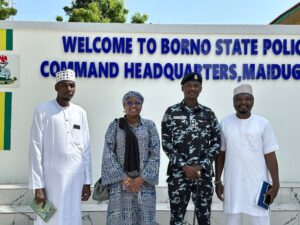
“So we should thank CDD really for this, and we will fully be a part of it,” ASP Daso assured.
He recounts that in recent years the command has repeatedly had to issue public rebuttals to false claims, from fabricated reports of an attack on its own headquarters to unverified accounts of security incidents that spread panic long before the facts could catch up.
At the Borno office of the Independent National Electoral Commission (INEC), the Head of Department, Voter Education and Public Affair, Shuaibu Ibrahim, said the intervention could not have come at a better time. With the 2027 general elections approaching, he warned that MDH had become one of the most potent threats to electoral integrity, capable of depressing turnout, discrediting results and inflaming tensions between communities that must share a ballot box and a future.
Read Also: Borno Reintegrates 720 Former Boko Haram Fighters, Total Nears 10,000 – CLOCKWISE REPORTS
He singled out the emerging threat of artificial intelligence generated deepfakes, which he said were becoming rampant and increasingly difficult for ordinary voters to tell apart from reality.
One of the most consequential backing came from the Borno Emirate Council. In MMC, Alhaji Abba Bukar, the District Head of Maisandari, who serves as head of district heads in Borno and is a prominent figure within the Borno traditional institutions, received the delegation, endorsed the project and pledged the support of the emirate council.
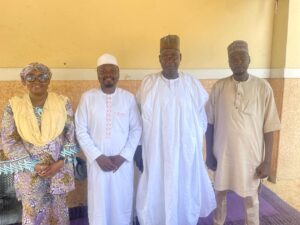
“With the level of how entrenchment traditional institutions are here, I can assure you that a falsehood corrected from the palace carries a weight no press release can match,” Alhaji Bukar assured.
The network gained one of its most practical boosts at the National Orientation Agency (NOA), where the Borno State Deputy Director, Mala Abba Kyari, received the team and keyed directly into the GLN.
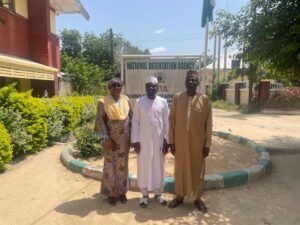
He offered to enlist the agency’s local government field officers across the project locations into the network to work alongside CDD. “This will help place trained public enlightenment officers inside the very communities where rumours are born and where corrections must land,” he said.
The Borno State Chapter Chairman of the Nigeria Union of Journalists (NUJ), Abdulkarim Haruna, lauded the initiative and pledged the full support of journalists in the state. He noted that such commitment from the NUJ is important in an environment where newsrooms are both a first line of defence against falsehood and, at times, an unwitting channel for it.
The delegation also called on the Nigerian Correctional Service, Borno State Command, where its spokesperson, Superintendent of Corrections A.B. Thliza, welcomed the initiative, thanked CDD and pledged the command’s participation. At the Borno State Emergency Management Agency (SEMA), the team was received by the Personal Assistant to the Director-General, who conveyed the agency’s support.
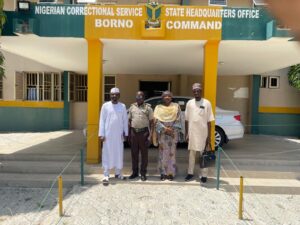
Together, the engagements produced a coalition that now spans security, justice, elections, humanitarian response, public enlightenment, the press and the grassroots.
CDD’s Admin and HR Officer, Ammi Hassan, who accompanied the delegation, said the warmth of the reception reflected a problem everyone already recognised. “In every office we entered, people already had a story about how a rumour or a hateful post had caused real harm,” Hassan said.
“They did not need to be convinced that MDH is dangerous. What they wanted was a structure for working together, and that is exactly what this project offers.”
Read Also: Beyond Scrolls: FIAP and FactCheckAfrica Train Northern Influencers on Electoral Misinformation
Beyond the courtesy calls, the project is designed to operate where information actually spreads including the household, market, mosques, churches, schools and WhatsApp groups.
The project engages and train GLN members as the frontline of a centralised information guard across MMC, Jere and Konduga, all capable of carrying the work forward long after the project cycle ends.
CDD’s Head of Programmes, Mary Okpe, said the Borno intervention reflects a conviction that has shaped the organisation’s work for years: that democracy and peace stand on the same foundation, a shared set of facts.
“Information integrity is no longer a side issue for democracy and development work. It is the ground on which everything else stands,” Okpe said. “When citizens cannot trust what they see and hear, elections lose credibility, communities lose trust in one another, and disputes that could have been settled through dialogue turn violent. In Borno, we are working with the institutions and communities closest to these dynamics, because sustainable solutions have to be owned locally.”
She added that the lessons emerging from the three local government areas would inform CDD’s wider work. “What we learn in MMC, Jere and Konduga will shape how we approach information integrity across Nigeria and the wider West African region, particularly as we move into a critical election cycle.”
Since its founding in 1997, CDD has built a reputation as one of West Africa’s leading democracy and governance institutions, known for its election observation and analysis, its research on security and violent extremism, and its pioneering fact-checking and counter-disinformation work.
The Borno project, supported by the Kingdom of the Netherlands, carries that record into one of the most complex information environments on the continent.